
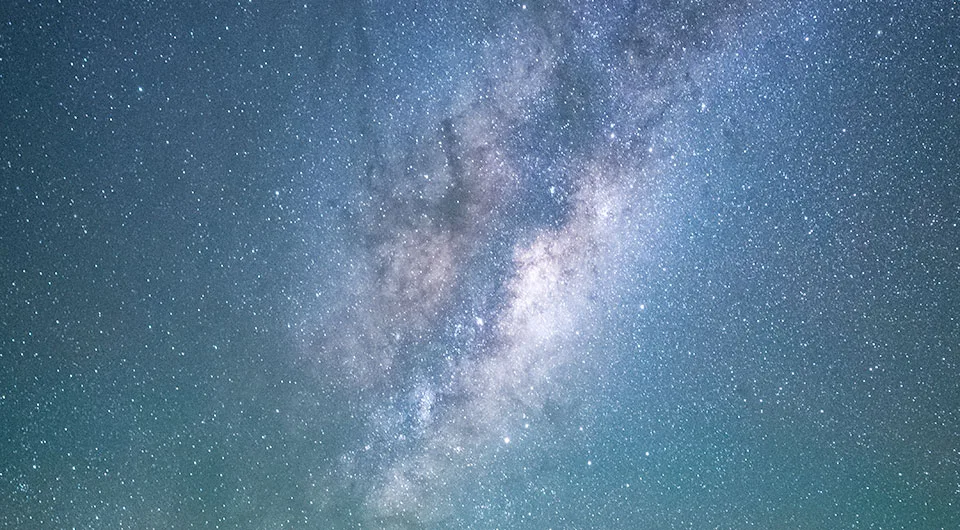
Step outside after dark on Aotea Great Barrier Island and look up. What you’ll see will stop you in your tracks. Not a handful of stars, not the faint smudge of the Milky Way you might glimpse from a rural hillside — but thousands upon thousands of stars, so dense and bright they seem almost unreal. The kind of sky that makes you feel very small, and very fortunate.
This isn’t an accident of geography. It’s the result of something rare, deliberate, and officially recognised: in 2017, Great Barrier Island became an International Dark Sky Sanctuary — and to understand why that matters, it helps to know what that actually means.
Not All Dark Skies Are Equal
Most people have heard of “dark sky” places — national parks or rural areas that try to limit light pollution. But the International Dark-Sky Association, the global body that certifies these places, recognises several distinct tiers. At the top sits the Dark Sky Sanctuary — and it is in a category of its own.
A Sanctuary is not simply a place with less light pollution. It is reserved for locations that are among the most isolated, most fragile, and most genuinely dark on the entire planet. Places where the night sky is so exceptional, and the threats to it so real, that the status is granted to formally protect it for future generations.
When Great Barrier Island received its designation in 2017, it became only the third Dark Sky Sanctuary in the world. The other two were both remote, uninhabited wilderness areas — one in New Mexico, one in Chile. Great Barrier was something different entirely: an inhabited island, home to a community of around 900 people, within 100 kilometres of one of the Southern Hemisphere’s largest cities. Yet its skies qualified as among the darkest on Earth.
That is extraordinary.
Why the Sky Here Is So Dark
Three things combine to make Great Barrier Island’s night sky what it is.
The island has no reticulated electricity. There are no power lines, no street lights, no illuminated billboards, no traffic lights. Every home and business generates its own power — solar panels, wind turbines, generators. The result is an island that, after dark, produces almost no artificial light at all.
The ocean creates a natural buffer. Auckland sits 100 kilometres to the southwest, across the Hauraki Gulf. That stretch of open water means the light dome from one of New Zealand’s largest cities simply doesn’t reach the island. On a clear night, the gulf swallows the glow entirely.
The community protects what it has. Islanders have understood the value of their dark sky for decades, long before the official designation. The application for Sanctuary status was a community-led effort, involving local residents, Auckland Council, the Department of Conservation, and local iwi. Maintaining the designation requires ongoing commitment to responsible lighting practices — and the island takes that seriously.
The result? On a clear night, you can see ten times more stars from Great Barrier Island than from Auckland. The Milky Way isn’t a suggestion — it’s a river of light spanning the entire sky. The Magellanic Clouds, two dwarf galaxies invisible from the Northern Hemisphere, hang clearly in the south. On the right nights, with the right solar conditions, even the Aurora Australis — the Southern Lights — has been seen from the island’s shores.
Winter: Why the Best Stargazing Isn’t in Summer
Most visitors come to Great Barrier in summer. For stargazing, that’s the wrong season.
Winter (May–September) is when the island’s dark sky reaches its full potential. Cold air holds less moisture than warm air, which means less atmospheric turbulence, less haze, and dramatically sharper views. Stars that appear as soft smudges on a humid summer night resolve into crisp points of light in winter. The Milky Way goes from impressive to overwhelming.
The nights are longer too. Darkness falls well before 6pm in the depths of winter, giving you five or six hours of prime sky before midnight. In summer, you’re waiting until 10pm for darkness and losing the best hours to exhaustion.
Then there’s the quiet. Summer brings visitors and activity. Winter on Great Barrier is near-empty — the beaches are yours, the bush tracks are yours, the night sky is yours. You’re not sharing it with anyone.
The houses are built for it. Wood burners in every property. You light the fire, you eat, you step outside into one of the darkest skies on the planet, and you come back in when you’re ready. No rush. Nowhere else to be.
Winter also brings Matariki — the rise of the Pleiades in late June or early July, marking the Māori New Year. On an island that has held the sky in such reverence that it sought global certification to protect it, Matariki carries particular weight. If you’re going to witness it anywhere in New Zealand, this is the place.
Winter availability is open. If you’re thinking about it, see our stargazing accommodation guide or check dates directly.
Stargazing at Medlands Beach
Great Barrier Island’s celebrated stargazing operator, Good Heavens, runs guided experiences from the sand dunes at Medlands Beach — meaning you’ll hear waves breaking on the shore while you gaze up at the Milky Way. Their small-group sessions include telescopes, laser pointer constellation tours, and the kind of commentary that makes the cosmos feel genuinely accessible, not just spectacular.
Medlands Beach, of course, is also home to 175° East.
Dark Sky Accommodation on Great Barrier Island
If you’re looking for dark sky accommodation in New Zealand, Great Barrier Island is the answer — and it’s not a close competition. Our three houses — Pītokuku (sleeps 10), Ruru (sleeps 7), and the Tree House (sleeps 8) — sit at Medlands Beach, each with generous decks oriented to make the most of the surrounding landscape.
As genuine off-grid stargazing accommodation in NZ, the houses are solar-powered and produce almost no light of their own. Step off the deck after dinner and you’re already standing in one of the world’s most certified dark skies, with nothing between you and the universe.
Winter is the best season for stargazing here — longer nights, colder (clearer) air, and the island at its quietest. Read our winter guide for the full picture. Rates from $225/night.
No telescope required. No guided tour necessary (though we’d recommend Good Heavens for at least one night). Just a clear evening, a glass of something good, and a sky that will make you feel like you’re seeing the world properly for the first time.
That’s what a Dark Sky Sanctuary actually means. And there are only a handful of them left on Earth.
When you’re ready — the three houses are here. Not sure how to get there? Our complete guide to getting to Great Barrier Island covers everything. And if you want to explore what else the island offers, start with the area.