
It’s October 1894. The SS Wairarapa — one of the fastest passenger steamers in the New Zealand fleet — is making the overnight run from Sydney to Auckland. At eight minutes past midnight, it strikes rocks near Miners Head on the northern tip of Great Barrier Island.
The full account sits in our guide to the Wairarapa and Wiltshire shipwrecks on Great Barrier Island.
About 140 people drown. It is one of the worst maritime disasters in New Zealand history.
The tragedy is compounded by a problem that seems almost impossible to us now: nobody in Auckland knows it has happened for days. Great Barrier Island sits 90 kilometres from the city, with no telegraph cable, no telephone, and no reliable way to get a message across the Hauraki Gulf quickly. By the time rescue ships arrive, most of the survivors have already been waiting on a remote coastline for two days.
Something had to be done.
Enter the pigeon
Three years later, a man named Barry took a different approach. If you couldn’t string a cable across the Gulf, you could send a bird.
On 14 May 1897, the Great Barrier Island Pigeon Post launched its first service — and with it, Great Barrier Island became the site of the world’s first commercial airmail service. Not France. Not England. Not the United States. A small island off the coast of Auckland, New Zealand.
The route was simple: homing pigeons were trained to fly between the island and a loft on the mainland. A message would be written on thin paper, rolled tightly, and attached to the bird’s leg. The pigeon would then fly 90 kilometres across open ocean to deliver it. In favourable conditions, the crossing took under two hours — faster than any ship.
The demand was immediate. Residents needed to communicate with the mainland. Journalists wanted to file reports. The mining and logging industries operating on the island needed to send orders and updates. The pigeons were working birds.
The stamps
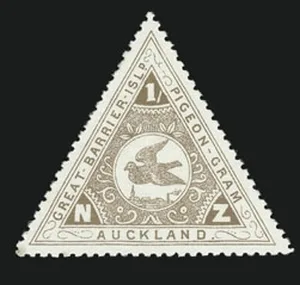
In October 1898 — a full year into service — special postage stamps were issued for the Pigeon Post. Two denominations: sixpence and one shilling.
They are, today, among the rarest and most sought-after stamps in New Zealand philately. A single Pigeon Post stamp in good condition can fetch thousands of dollars at auction. The design shows a pigeon in flight, wings spread, carrying its cargo across the Gulf.
The service ran for a decade. In 1908, an undersea telegraph cable was finally laid to the mainland, and the birds were retired. The 175 East Journal was officially redundant.
But the legacy is permanent: Great Barrier Island holds a legitimate claim as the birthplace of commercial airmail — beating the first airplane airmail service by over a decade.
A pattern, not a coincidence
The pigeon post story isn’t an isolated quirk. It’s part of a pattern that runs through Great Barrier Island’s entire history.
This is an island that was off-grid before off-grid was a concept. Where the first Polynesian navigator Kupe made landfall, guided by stars, centuries before Europeans arrived. Where New Zealand’s oldest mine was dug in 1842. Where the last whaling station in the country kept operating until 1962. Where Radio Hauraki’s pirate ship ran aground at Whangaparapara in 1968 — and the DJ kept broadcasting live commentary as the hull came apart on the rocks.
When the rest of New Zealand couldn’t or wouldn’t, Great Barrier found a way.
The solar panels and Starlink dishes you’ll find on the island today — including at 175° East — are the latest chapter in the same story. The island was never connected to the national grid. So it built its own power system, decades before the rest of the country started talking about renewable energy.
Off grid for life. And apparently, ahead of schedule.
Want to experience Great Barrier Island for yourself? Three off-grid houses at Medlands Beach — Pītokuku, Ruru, and the Tree House — walk to the surf, sleep under some of the darkest skies in the Pacific. Check availability →
Planning your trip? Read more about the island and what to do here →