
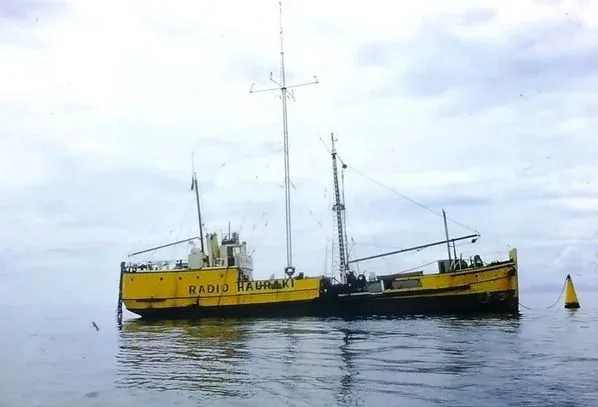
It’s 28 January 1968. The MV Tiri — a 30-metre yellow ship broadcasting illegally from international waters — has left its mooring in the Colville Channel to help search for a missing fisher. Then the engine fails.
A storm rolls in. The wind picks up. And slowly, inevitably, the wooden vessel is driven toward the rocks at the entrance to Whangaparapara Harbour, Great Barrier Island.
On board, disc jockey Derek King does what any sensible professional would do. He keeps the microphone open and starts broadcasting a live commentary of the ship’s destruction.
As the hull begins to pound the rocks, DJ Paul Lineham steps in to play one final track — Electric Prunes, he announced, “with background music courtesy of King Neptune.”
Then they abandoned ship.
How it started
To understand why a yellow pirate radio ship was floating off the coast of Great Barrier Island in 1968, you need to understand what New Zealand radio sounded like in 1966.
It was run entirely by the New Zealand Broadcasting Corporation — a state monopoly with a tight grip on what went to air. Parliamentary debate was broadcast at length. The Rolling Stones were routinely refused airtime. The weekly chart show, the Hit Parade, ran for exactly thirty minutes.
Two men decided they’d had enough: David Gapes, a rebellious Wellington journalist, and Denis O’Callahan, who would become the ship’s skipper. Their model was Radio Caroline — a British pirate station that had been broadcasting from a ship in the North Sea since 1964, fighting the BBC’s own monopoly.
They bought the Tiri, painted it yellow, loaded it with prerecorded music, and pointed it at Auckland.
The first broadcast
The NZBC wasn’t going to give up without a fight. In September 1966, marine inspectors blocked Tiri from leaving port. A month later, police attempted to lower Auckland’s Viaduct drawbridge to stop the ship getting out. The crew slipped through anyway, were pursued and arrested at sea, and won the subsequent court case.
On 4 December 1966, at 11am on a Sunday morning, Radio Hauraki went to air. The first sound Aucklanders heard on 1480 AM was seagulls. Then a documentary. Then Matt Munro singing Born Free.
The phones, reportedly, went mad.
1,111 days at sea
Over the next three and a half years, Tiri and its successor endured everything the Hauraki Gulf could throw at them. The Whangaparapara wreck in January 1968 was just one episode. Within a month, a replacement vessel was at sea.
That ship — Tiri II — was later torn from its moorings by a storm so violent it was driven 80 kilometres across the Gulf before washing ashore. Miraculously, it landed on a sandy beach rather than rocks.
The government eventually conceded. Private radio was legalised, the airwaves opened up, and after 1,111 days at sea, the pirates came ashore.
The return wasn’t entirely triumphant. DJ Rick Grant was lost overboard on the voyage in.
A piece of the ship is still on the island
The yellow mooring buoy from the Tiri — the one visible in the photo above — is on display at the Claris Art Gallery on Great Barrier Island. It’s the kind of artefact that stops you mid-stride: a battered yellow float that was once tethered to a pirate radio ship, floating illegally in international waters, broadcasting the Rolling Stones to a city that wasn’t supposed to hear them.
Worth a look if you’re passing through Claris.
Why this matters to Great Barrier Island
Whangaparapara Harbour, where Tiri came to grief, is a quiet anchorage on the western side of Great Barrier. Today it’s a DOC campsite, a launching point for walking tracks, and the site of New Zealand’s last whaling station — which itself only closed in 1962, just six years before the Radio Hauraki wreck.
That concentration of history in one small harbour is not coincidental. Whangaparapara was a working port — a place where things happened precisely because it was remote enough to operate outside the normal rules.
That thread runs through Great Barrier Island’s entire story. Kupe’s landfall. The first mine in 1842. The pigeon post — the world’s first commercial airmail service, run from this island in 1897. The last whaling station. The pirate radio ship.
This island has always been where things happen that aren’t supposed to happen anywhere else.
The wreck site isn’t visible today, but Whangaparapara is worth the drive — a beautiful harbour, good kayaking, and that particular kind of quiet that Great Barrier does better than anywhere. Stay at 175° East — Pītokuku, Ruru, or the Tree House — and make the day trip. Check availability →
Want to explore more of the island’s history and landscape? The Area →